
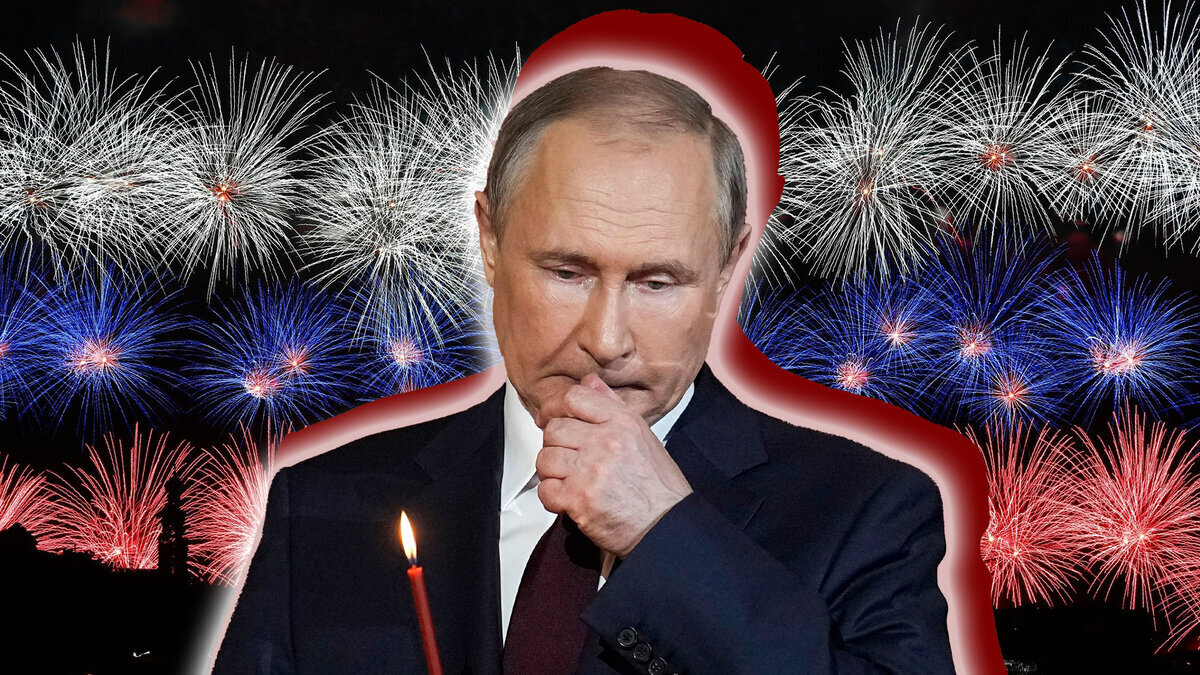
Putin's Three Mistakes Leading Russia to Hyperinflation

“Only the one who does nothing is not mistaken,” says popular wisdom and it is difficult to argue with it. However, when someone who has been in power for almost a quarter of a century makes a mistake, it causes bewilderment. The feeling is heightened when we see the consequences of such mistakes in the field of the economy, as they inevitably accelerate inflation and make us all poorer.
What is inflation and how is it classified?
There are a lot of definitions of inflation, but in short, it is a complex of economic processes, the result of which is an increase in prices.
“Only the one who does nothing is not mistaken,” says popular wisdom and it is difficult to argue with it. However, when someone who has been in power for almost a quarter of a century makes a mistake, it causes bewilderment. The feeling is heightened when we see the consequences of such mistakes in the field of the economy, as they inevitably accelerate inflation and make us all poorer.
What is inflation and how is it classified?
There are a lot of definitions of inflation, but in short, it is a complex of economic processes, the result of which is an increase in prices.
Some people think that inflation is a negative process in itself, but this is not so. In a capitalist society, it helps to develop business and accelerates economic turnover. However, depending on the rate of inflation, it can play both a positive and a negative role.
Moderate (creeping) inflation.
It is characterized by a price growth rate not exceeding 10 percent per year. With such inflation, the best aspects of capitalism are manifested, namely, the growth of production, an increase in labor productivity, a high level of trade and exchange of goods and services, and the rapid accumulation of material wealth. In developed countries, the inflation rate is 3-7 percent per annum and is typical for the United States and the European region.
galloping inflation.
Differences in price growth over 10, but not more than 30 percent per year. With this level of inflation, it is difficult for the population to buy expensive goods and services, and it is difficult for businesses to make plans for years to come. Nevertheless, special economic measures can moderate inflation and help achieve the inflation target. I think you already have an understanding that galloping inflation is most often observed in Russia.
hyperinflation.
Accompanied by price increases of over 30 percent per year, but rarely set to the indicated value. During hyperinflation, as a rule, the increase in prices is about 100 percent or even more. At such a rate, money ceases to carry out the function of intermediary in commodity exchange, barter exchange begins to grow, and the population instead of its own currency increasingly uses conventional units (dollars, euros, yuan, bitcoins, and others, but not its own country currency).
Putin's mistakes that lead Russia to hyperinflation.
It was mentioned above that Russia has entered the phase of galloping inflation and may soon find itself in an economic situation with hyperinflation. In many respects, this will happen due to systemic mistakes that our President made.
All of the errors below are different in nature, but they have a similarity - a common foundation based on political populism, inflated and obviously unrealistic social promises. Here are just a few of them.
Mistake #1 – Implementation of national projects.
They are understood as federal programs designed to improve the quality of life of citizens, increase the comfort of the living environment and give economic growth. The system of national projects is quite extensive and at the same time deep, but it is good only on paper. In fact, the implementation of national projects only led to the commission of lawlessness, the growth of bureaucracy and the strengthening of already not the lowest corruption. It must be admitted that the system of national projects is a clear mistake by Putin, which led to the squandering of billions of dollars and did not bring visible success. Of course, it is possible and necessary to try to improve the lives of ordinary citizens, but not at the cost of uncontrolled allocation of money and at the cost of a sharp acceleration of inflation.
Mistake no. 2 - Bet on the extraction of subsoil and their sale abroad.
A distinctive feature of the entire period of Vladimir Putin's rule was that the President completely removed himself from the support and development of industrial enterprises, bankrupting or transferring to private hands what Yeltsin did not have time to distribute. However, with special effort, the development and extraction of subsoil began in those regions that, under the USSR, were considered of little interest in terms of profitability. Today, Russia lives solely by extracting resources on its own land and selling them abroad, that is, we have become a complete raw material appendage of developed countries. However, the unprecedented sanctions that hit our country dealt a severe blow to budget revenues, due to which it became sharply in deficit.
Mistake no. 3 - Increasing the salaries of state employees and payments to pensioners.
Another populist decision by Putin was expressed in the alleged assistance to state employees and pensioners. In fact, it was not there, because in the conditions of galloping inflation, any measures of targeted support are automatically transformed into selective indexation (with the absence of it for all those who for some reason did not deserve it). As a result of the unjustified increase in wages and pensions, there was a powerful injection of new money into the economy, which was not supported by a similar injection of new goods and services into the market. As a result, inflation accelerated as expected. For those who do not fully understand the fallacy of the mechanics chosen by Putin, I will explain in a simpler way - if the salaries of state employees and pensions had not increased,
Why the start of a special operation does not accelerate inflation.
Many readers will notice that the article does not say a word about the special operation and its impact on inflation. I will say that it does not affect the level of inflation in any way - it does not accelerate it, but it does not slow it down either. This may surprise you, but in fact the operation is only a consequence of future hyperinflation, which Putin himself foresaw and decided to fight preemptively. If the operation had not started, then we would still have received a multiple increase in prices for everything for the three reasons that were described above. Thus, the start of a special operation may well be a consequence of economic failures and mistakes of the President, which resulted in the acceleration of inflation, but certainly not vice versa.